Handbook
The Land and Crown Handbook
Everything you need to rule your land, in the same words the app uses. Pick a chapter or read from the start.
Last updated 23 September 2026. In the app: Settings › Guide & manual.

Chapter 1: First Steps
What it is about
You are a lord of the land. Your farmsteads feed you, your county shields you, and your armies decide what belongs to you.
The goal of a season is the crown: whoever reaches 15,000 points, holds them for a full day, and stays the top scorer becomes king — and ends the season.
The Season
A season runs for 21 days. If no one reaches the crown by then, whoever is ahead at the end wins.
When the season ends, everything starts over: new land, a new county, a free choice of people. Only a few things carry over — your account, your portrait, your opponent notes, and the Hall of Fame.
People and county
When you join, you choose a people. The choice holds for the whole season and shapes how you fight and march — more on that in the chapter The Peoples.
Your county is assigned to you by lot. You do not pick your neighbors here; you stick together: members never attack one another.
Starting together with friends
Agree on a secret word. Everyone who enters the same word is drawn into the same county at the start of the season — up to all six seats.
The word only works in the first 48 hours of a season. Anyone who joins in the middle is with their friends only in the next season. Moving mid-game would be an escape hatch from approaching armies.
How you make progress
First you grow: build farmsteads and use the distribution key to set which goods they produce.
Then you secure yourself: walls, the watchtower, and defense towers protect your land.
Finally you arm: armies and bailiffs conquer foreign farmsteads out there — and bring you closer to the crown.

Chapter 2: The Peoples
What your people changes
Your people touches only combat, marching, and scouting — never the economy. All four earn the same.
The choice holds for the whole season. Think about whether you would rather attack, defend, or work from the shadows.
The Realm
Balanced: attack, defense, and walls all count normally.
Its strength is speed — the Realm's messengers and armies travel one bell toll faster than those of the other peoples.
The Guilds
The bulwark: defense counts one and a half times over, and walls count one and a half times too.
In return, their attack is a little weaker. The Guilds win by standing firm where others fall.
The Northmen
The blade: a quarter more force in attack.
The price is a thinner defense. The Northmen conquer quickly — and cannot afford a long siege at home.
The Forest Folk
The hidden ones: on the approach their armies are reported at only half their true size, and foreign watchtowers miss them in only a quarter of cases. Their attack is a touch weaker.
Only the Forest Folk can sabotage: for 120 silver they cut a target's farmstead yield in half for three hours — the ancestral keep is spared.
Scouting is its home ground: it trains spies at half price, and its parties set out a quarter stronger.

Chapter 3: Land and Economy
Farmsteads and labor
Farmsteads are your economy. Each farmstead produces one hundred labor every ten minutes.
The economy flows continuously, around the clock, even when the app is closed. There is no economy tick — your goods grow by the second.
The distribution key
With the key you distribute your labor across wood, stone, iron, and silver. The four values always add up to one hundred.
Wood is cheap and comes in bulk; silver is expensive and scarce. You can change the key at any time, and it takes effect immediately.
Processing
Each good has two processing levels. Upgrading to level two doubles that good's output for the rest of the season.
The upgrade costs goods once. There are no more than two levels — beyond that you grow through farmsteads and conquest.
Ancestral keep and farmstead costs
Your ancestral keep delivers a fixed basic income no matter what — every ten minutes twelve wood, six stone, four iron, and three silver. It cannot be attacked and is untouched by sabotage.
Each further farmstead costs more than the last; the curve rises with the square. From about half of the reachable farmstead count, growth barely pays off anymore — then what counts is what you do with your land.
Chapter 4: Defense
The wall
The wall adds defensive strength and provides cover for archers and archer towers. The cover grows evenly with each level; the defensive strength grows disproportionately — a high level contributes far more than a low one and costs accordingly. A well-developed wall can therefore cover more shooters and protect your army considerably better.
Catapults can negate wall levels for the current battle. Both the defensive strength and the cover from those levels are lost during that battle. The built wall level remains intact afterward.
The wall goes up to level ten. Higher levels cost increasingly more. Weigh upgrades against additional troops and other fortifications.
The watchtower
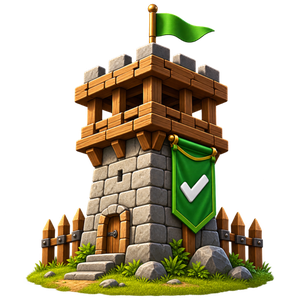
The watchtower reports approaching armies before they arrive. It has three levels.
Level one spots about every third departure, level two two out of three, level three every one. Undetected armies arrive in silence.
The three defense towers
Defense towers are stone structures built individually. They fight only at home, never march, and can be destroyed in battle — by the fighting itself and, in addition, by catapults that come specifically for them and shell them before the battle begins.
The bastion contributes its own attack and defense and ties down enemy lancers. It provides no cover for archers or archer towers; those need spearmen or walls.
An archer tower needs cover to shoot. Archers and archer towers share the cover provided by spearmen and effective wall levels. Bastions and forts provide no cover. Unlike archers, an archer tower cannot be harried by enemy lancers.
The fort deals no damage but adds defensive strength. Forts protect wall levels from being negated by catapults, preserving the cover of those levels as well. That is exactly why catapults aim at the forts first: only once none is left do they turn on bastions and then on archer towers. Even when the forts fall before the battle, they still hold their shield over the wall during that battle.
Building slots and limit
Each tower type has its own building slot: bastion, archer tower, and fort are built in parallel, up to three sites at once.
Your land carries at most two defense towers per farmstead, all types counted together and anything still under construction included. If you lose farmsteads, standing towers remain — only new building is then blocked until you have farmsteads again.
Chapter 5: The Army
Spearmen
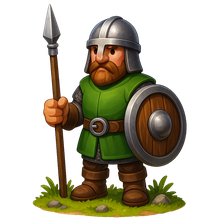
Spearmen fight and add resilience to your army. They also tie down enemy lancers: tied-down lancers deal no damage, but still contribute to defense and can be lost.
Spearmen provide cover for archers and, when defending, archer towers too. They have three roles: fighting, tying down lancers, and covering shooters. Bastions also fight and tie down lancers, but provide no cover.
Lancers
Lancers bring high attack power but little resilience to an army. Enemy spearmen tie them down, preventing them from dealing damage. Spearmen therefore counter lancers.
Lancers that are not tied down contribute to the whole army’s damage. In addition, all lancers harry enemy archers: each lancer keeps two of them from shooting, even while spearmen tie it down. Archer towers cannot be harried.
Archers
Archers deal damage only when covered. When attacking, spearmen provide that cover. When defending, wall levels at the target that have not been negated by catapults provide additional cover.
If there is not enough cover for everyone, only the covered portion shoots. Uncovered archers deal no damage, but still contribute to defense and can be lost. Archer towers share the available cover with archers.
With enough cover, archers deal the most damage, especially against a wall of spearmen. Enemy lancers harry them, though: for each lancer, two archers fall silent. Against an army with many lancers, spearmen therefore help more than additional archers.
Catapults
When attacking, catapults weaken the wall for your whole army. They do not merely bypass it for their own damage: negated levels provide the enemy with neither defense nor cover during that battle. Forts can protect wall levels from this effect.
Before the battle, catapults shell the defense towers: one tower per catapult, forts first, then bastions, then archer towers. Towers shot down take no part in that battle and are destroyed for good — even when your attack loses the battle.
Catapults have little attack power or resilience of their own. Against a target with neither a wall nor defense towers they lose their siege advantage entirely. At home they defend alongside every other troop type. They complement a mixed army; no unit has a special damage bonus against catapults.
An army marches together. If it includes at least one catapult, the march takes one extra bell stroke. Additional catapults add no further delay; individual troop types do not have separate marching speeds.
How troops work together
Troop types contribute to the combined army’s attack and defense, and each has its task: spearmen tie down lancers, lancers harry archers, archers break the wall of spears, catapults break towers and walls. No troop type wins alone — the mix is what matters.
The bailiff does not fight: after a victory he stays behind on a conquered farmstead and administers it for you. One bailiff, one farmstead.
Training piece by piece
Training takes time, and each unit steps forward on its own as soon as its own time is up — finished ones already help defend while the rest are still drilling.
A spearman takes thirty seconds, an archer forty, a lancer sixty, a bailiff ninety, and a catapult two minutes. Each field army has its own queue; all three armies and the spies train independently and therefore in parallel.
You can only order new units for an army that is at home. If that army marches out with an active queue, its training pauses completely and resumes with the remaining time when the army returns.
The drill ground
The drill ground speeds up all training. Each of its eight levels makes it one quarter faster; fully built, training runs ten times as fast. The upper levels cost mostly silver — faster training is a purchase, not a gift.
It is also a sink for surplus — each level costs noticeably more than the one before.
Armies and orders
You command up to three field armies. A running training or building order can be cancelled; whatever is not yet built is fully refunded, and finished units remain.
To conquer you need bailiffs: when your army wins, one conquered farmstead stays permanently in your hands for each bailiff you brought along. One bailiff, one farmstead.
Chapter 6: Understanding Combat
Roles in your army
Spearmen are the backbone of every army: they fight, tie down enemy lancers, and provide cover for archers. Lancers bring high attack power and harry enemy archers so they cannot shoot, even while spearmen tie the lancers down. Archers deal the most damage but need cover and fall silent when lancers harry them. Catapults shoot down defense towers before the battle and break walls; in the open field they are weak and slow your army down. Bailiffs hold conquered farmsteads after a victory.
In short: spear holds lancer, lancer harries archer, archer breaks the wall of spears, catapult breaks towers.
Cover and fortifications
Bastions fight and tie down lancers but provide no cover for shooters. Archers and archer towers share the cover provided by spearmen and, when defending, effective wall levels. If there is not enough cover for everyone, only the covered portion shoots. Enemy lancers harry only archers, never archer towers.
Higher wall levels strengthen defense disproportionately and provide more cover. Catapults can weaken this protection during a battle, helping the whole attacking army. Forts protect wall levels from catapults but deal no damage themselves — and are the first to be shelled when catapults clear the defense towers before the battle.
Marching speed
All troop types march together with their army. Catapults increase its travel time. Plan their arrival alongside the rest of your attack.
Common situations
You have many archers but little cover: adding more archers alone will do little. Spearmen allow more archers to shoot and can also tie down enemy lancers.
You are building archer towers: provide cover through spearmen and walls. Extra bastions strengthen your defense but do not solve a shortage of cover.
You are attacking a fortified position: catapults weaken the wall and thus help your whole army, and before the battle they shoot down defense towers, which then take no part in the fight. Against a target with neither a wall nor towers, they lose this advantage.
Your enemy relies on many archers: your own lancers silence them, even while his spearmen tie them down.
Your enemy brings many lancers: some of your archers will fall silent. Spearmen tie the lancers down and help more than additional archers; archer towers keep shooting.

Chapter 7: War and Conquest
The march
Armies move in bell tolls — one step every fifteen minutes. Marching into a foreign county takes six bell tolls; defense rushes in one faster. Within your own county only defense is possible — it arrives after three bell tolls.
The target's border watchtowers cost one toll more, and so does a catapult brought along. The Realm is one faster — but never under two bell tolls.
Whom you may attack
You can attack and defend any player outside your county — no one is too strong or too weak for you. Only someone in the protection zone or locked stays off limits.
If your army finds the target in the protection zone on arrival, it turns back — so attacking someone about to slip into protection comes to nothing.
The battle
Battles are fought on the combat tick, every fifteen minutes — the one bell toll. First the catapults shoot down defense towers, then spears tie down the cavalry and catapults press against the walls. Lancers harry the enemy archers, then everyone who is free and covered strikes.
If a return, a defense arrival, and an attack fall on the same bell toll, your own armies return home first, then arriving support takes position. Only then are all attack armies that arrived together resolved in one shared battle.
The winner is whoever loses less in proportion to the army they committed. A small, well-mixed force beats a large, badly mixed one.
The battle report
Defenders and their supporters always see the complete battle report. As the attacker, you learn the exact enemy formation only if at least one of your units survives or your attack destroys at least a quarter of the enemy army value.
If your army is wiped out without effect, the report shows only the outcome and your own losses — enemy troops, fortifications, and supporters remain unknown. Scouts are there for a quick look before battle.
Conquering and defending
A victory takes at most fifteen percent of the defender's farmsteads — and only as many as you have surviving bailiffs along. There is no fixed limit per army: against a large neighbour, a large push pays off.
Defending means: your field army marches to a player and takes a stand there. You can defend anyone; your own county you can only defend, never attack.

Chapter 8: Scouting
The spy camp
Build a spy camp, and you can train spies — your fourth army, which never marches into battle.
The camp has three levels, and each makes training cheaper: sixty, forty-five, then thirty silver per spy. The Forest Folk pay half. You can train up to 5,000 spies at once.
Dispatching parties
You send a party to a target in a foreign county. It is on the road for two bell tolls; then the report arrives as a message — or word that it was caught.
Dispatched spies are missing at home. Anyone who sends them all out stands without defense when foreign parties arrive.
The duel
At the target, your party duels number against number with the target's spies left at home. Each watchtower level counts there as three additional guards.
Your county's scout network and the Forest Folk each make your party a quarter stronger. Losses are proportional — halved on success, but even a successful look costs spies.
The report
A successful party shows buildings, towers, and walls precisely, and the number of troops only roughly — the larger the party, the sharper the view.
A fully built watchtower at the target exposes a caught party and tells the victim who it came from.
Chapter 9: The County
Your neighbors
Your county holds up to six players, assigned by lot for this season. Members never attack one another.
Help has short paths — defense arrives within the county faster than any foreign army.
Treasury and donations
The treasury belongs to everyone and fills through voluntary donations. What you donate then belongs to the county — forever; there is no taking it back.
In return, everything in the treasury is untouchable: it cannot be plundered, it cannot be conquered. It is the only safe wealth in the game.
Shared buildings
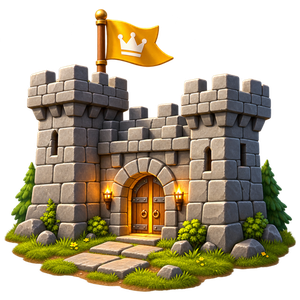
From the treasury, the county pays for its shared buildings. The county castle comes first — it is the prerequisite for everything else.
Border watchtowers cost foreign attackers one bell toll more of marching into your county. The scout network strengthens your scouting parties and opens a view into foreign counties.
The county council
The county council is your county's counsel room. Only its members can read along, and each message holds up to 280 characters.
It lasts for this season. Stay friendly: insults and contact details are not delivered.
The council hall and its timed boons
As the fourth community building, the council hall unlocks the timed boons — temporary boosts for the whole county, each activation paid from the treasury. This gives even a well-filled treasury a lasting use.
Drill order speeds up troop training by a quarter. Harvest feast raises every farmstead's yield by a fifth; its price grows with the economy it lifts. Land peace makes towers and walls defend more strongly.
Each boon lasts a while and then needs a cooldown before it can be called again. The count or castellan builds the council hall and calls its boons.
Chapter 10: Offices
The count
The count is elected openly — a simple majority of the members is enough. A new majority can elect someone else at any time.
Your vote counts immediately. As soon as a candidate has more than half of the members behind them, they are count.
The castellan
The count appoints the castellan from another member of the county. As long as there is no one to appoint, the action does not appear. The count cannot appoint themselves.
The count and castellan together build the community buildings from the treasury and call the council hall’s timed boons. Beyond that the castellan holds no powers of their own — they are the count’s right hand.
Both offices in one person are not allowed — the count cannot make himself castellan. Power is shared.
Exclusion
The count can exclude a member from the county — but only if that member is locked. A peaceful member cannot be forced out.

Chapter 11: Season, Crown, and Hall of Fame
Where points come from
Farmsteads are the leading currency: each farmstead is worth ten points. Walls and the watchtower count five points per level each.
Military deliberately counts for little — the entire value of your troops, defense towers, and spies is divided by a thousand. Whoever wants the crown builds land.
The road to the crown
The king's threshold lies at 15,000 points. Whoever reaches it must hold it for a full day and stay the top scorer.
If anyone overtakes you in that time, your hold starts over. If you make it through, you become king — and the season ends at once.
Leaderboard and Hall of Fame
The leaderboard has two standings: players are ordered by their points, while a county's score is the sum of all member points. Tied counties are separated first by their combined farmsteads and then by county number.
The season ceremony honors the three best counties alongside the leading players. Your final player rank and the rank of your county at the time are kept in your statistics for every season.
If the season ends without a king, the player with the most points wins. Your coronation is also immortalized in the Hall of Fame.

Chapter 12: The Crown Seal and Gifts
What the Crown Seal is
The Crown Seal is a monthly subscription for 4.99 euros. It renews automatically and can be cancelled at any time in your App Store settings.
The principle: what is sold is comfort and sound, never power. No purchase decides a battle or brings even a single grain of silver.
What it brings
Saved distribution keys, your own alert rules per occasion, opponent notes, the battle report archive beyond the end of the season, and an extended battle record.
Plus audible cosmetics — a victory fanfare, a horn blast, a spoken title line, your county's motto — and eight additional portraits that can only be chosen with the Crown Seal.
Gifting
You can gift a month of the Crown Seal — to a single player or to your whole county at once.
The recipient receives thirty days as a reserve; they only start running once he has no subscription of his own. Your generosity appears on the season's donors' board.

Chapter 13: Presence and the Protection Zone
The protection zone
As a newcomer you are in the protection zone: no one can attack you. This way you build up in peace. You may still attack — but then you give up the protection for the rest of the season; the app asks first.
The protection zone ends as soon as your land counts forty farmsteads. From then on you can be attacked — just like everyone out of protection.
When you are away for a long time
It is measured from your last sign-in, in three stages. After three days your land is considered dormant: any newcomer protection still in place ends early, and you can be attacked again.
After seven days your county seat is freed for active players — you keep your land and join a new county on your return. After fourteen days your land slowly returns to the wilderness: your farmsteads dwindle until you come back.
Whoever stays active loses nothing
As long as you look in regularly, none of these stages take hold. Each stage announces itself in the news, and on your return everything is back to normal at once.

Chapter 14: Sound and Accessibility
The situation report
The situation report sums up your position in a single sentence — farmsteads, armies, reported enemies, crown. It is read aloud to you in a narrator's voice.
Hearing and feeling
The alarm comes as a sound before it comes as text — you hear the attack before you read that it is coming.
The haptics carry the battle result as a vibration: won, lost, or close, felt without looking. No element depends on color alone.
VoiceOver first
The game is built for VoiceOver from the ground up. Everything important is announced; the screen is secondary.

Chapter 15: Reporting and Support
Names and conduct
Your name has three to twenty characters and goes through a check. You can rename yourself once per season — battle reports and notes are tied to the name.
In the county council you write only within your own county, with a short pause between messages. Stay friendly; disallowed messages are not delivered.
Reaching support
In the settings you will find your support number — eight characters in a four-four format. Give it to us, and your account is identified at once.
Write to us at info@kroegoor.com. The prepared support email already carries your number in the subject line.